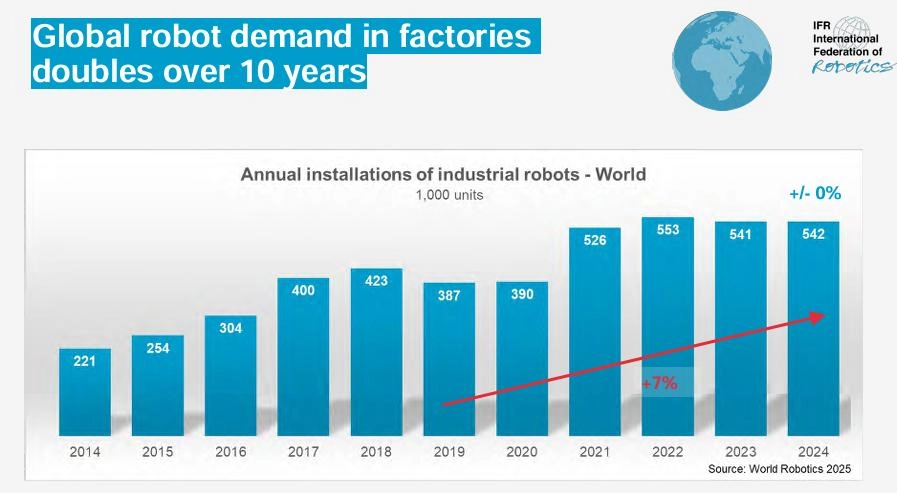
Robot development gains global momentum, as shown in the 2025 World Robotics Report. On September 25, the International Federation of Robotics (IFR) released this key industry document. In 2024, global industrial robot installations hit 542,000 units, doubling the 2014 figure. Annual installations exceeded 500,000 units for four straight years. Asia took 74% of new deployments, Europe 16%, and the Americas 9%. Robot development thus shows clear regional disparities worldwide.
Global Robot Development: Decade of Doubled Growth, Expanding Applications
Over the past decade, global robot development has doubled industrial robot demand. Installations rose from 221,000 units in 2014 to 542,000 units in 2024. Operational stock grew from 1.472 million to 4.664 million units in the same period. Both application depth and breadth continue to expand across industries. This fuels sustained progress in global robot development.
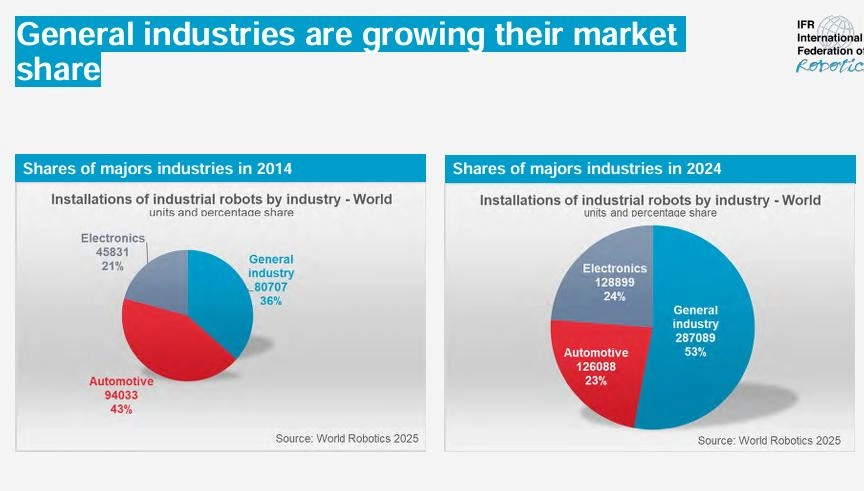
General industries lead robot adoption, driving robot development forward. Their installation share rose from 36% in 2014 to 53% in 2024. This offsets the automotive industry’s weakness and becomes the dominant sector. Key industry performances in 2024 vary significantly.
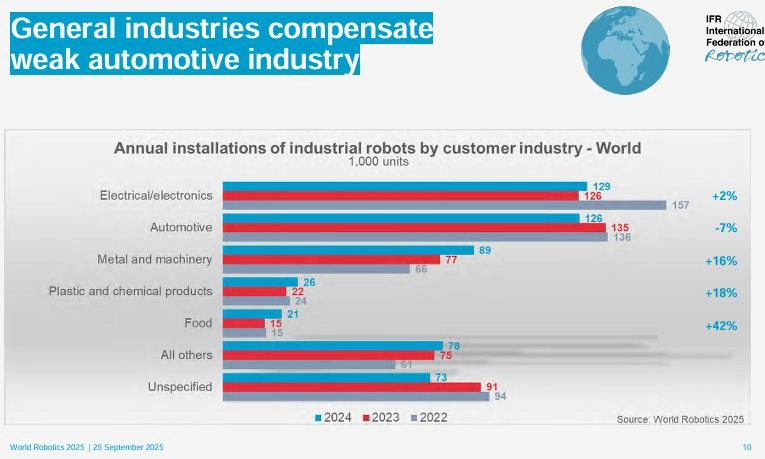
The electrical/electronic industry installed 129,000 robots, up 2% year-on-year. The automotive industry saw 126,000 installations, down 7% from the previous year. Metal and machinery, plus plastics and chemical products, both grew by 18%. The food industry achieved a remarkable 42% increase. These figures reflect diverse impacts on robot development across sectors.
Collaborative robots boost robot development with double-digit growth. Installations rose from 11,100 units in 2017 to 64,500 units in 2024. Their market share increased from 2.8% to 11.9%. They gradually integrate into mainstream industrial production. This enriches the landscape of global robot development.
The Asia/Australia region dominates global robot installations. In 2024, it installed 402,000 industrial robots, accounting for 75% of the global total. This regional strength significantly propels global robot development. China, as the largest market here, leads the way.
Regional Dynamics: Traditional Markets Slump, India Boosts Robot Development
Robot development shows sharp regional differences globally. Traditional core markets face collective decline in 2024. Japan, the US, South Korea, and Germany all recorded lower installations. India, however, surges to sixth place, driven by automotive demand. It becomes a key growth variable for global robot development.
Japan, the second-largest market, faces robot development bottlenecks. From 2014 to 2018, its installations grew from 29,000 to 55,000 units. Subsequent growth weakened, stabilizing around 46,000 units in recent years. 2024 installations dropped to 44,500 units, a 4% year-on-year decrease. Operational stock only grew 3% to 450,500 units.
Weak industry demand causes Japan’s robot development slowdown. Electronics and automotive sectors, core applications, saw notable declines. 2024 electronics installations fell to 13,900 units, down from 14,900 in 2023. Automotive installations dropped to 13,100 units, lower than 2023’s 13,900. These downturns urge Japan to find new robot development drivers.
The Americas region installed 50,100 robots in 2024, a 10% year-on-year decline. It has exceeded 50,000 units for four consecutive years but lacks momentum. The US dominates the region, accounting for 68% of its installations.
US 2024 installations fell 9% to 34,200 units from 2023’s 38,000. Most US robots import from Japan and Europe, with few domestic suppliers. Local integrators provide automation solutions to support robot development.
US automotive industry rebounded, installing 13,500 robots in 2024. This is up from 2023’s 12,300 units, though below 2022’s 14,500. It brings partial momentum to US robot development amid general industry weakness.
South Korea ranks fourth globally with 30,600 2024 installations, down 3% year-on-year. Since 2019, its annual installations have stagnated around 31,000 units. Insufficient growth leaves its robot development in a slump.
Europe installed 85,000 robots in 2024, an 8% decline but still the second-highest ever. 80% of these went to the EU, with 3% annual growth from 2019 to 2024. This growth stems from nearshore outsourcing trends.
Germany, Europe’s largest market, installed 27,000 robots in 2024, down 5% year-on-year. Its automotive sector saw a 25% drop to 6,932 units. The metal and machinery industry grew to 4,916 units, offsetting partial declines. This divergence shapes Germany’s robot development trajectory.
India’s robot development stands out with strong growth. It jumped to sixth place globally in 2024. Installations grew from 2,126 units in 2014 to 9,123 units in 2024, a 7% year-on-year increase. Its 2021 growth reached 16%, showing rapid momentum.
India’s automotive industry drives its robot development. 2024 automotive installations hit 4,073 units, accounting for 45% of total. This is up from 2023’s 3,537 units and 2022’s 1,475. Other sectors grew but remain smaller in scale.
Service Robots Fuel Growth, Humanoid Robots Lag in Robot Development
Service robots become a key driver of global robot development. IFR surveyed 293 of 944 manufacturers, revealing positive 2024 trends. All three major service robot categories achieved growth, boosting overall progress.
Specialized service robots (including AMRs) installed 199,000 units, up 9% year-on-year. Medical robots surged 91% to 16,700 units, showing exceptional growth. Consumer service robots added 20.1 million units, a 11% increase. These figures highlight vibrant service robot development.
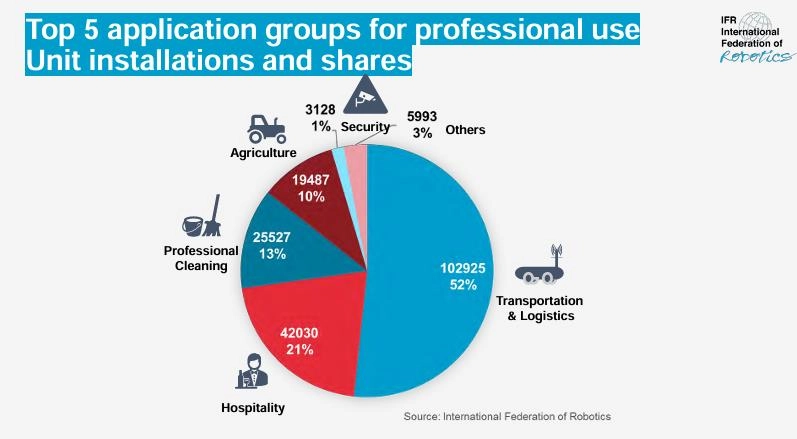
Transportation and logistics dominate professional service robot applications. It installed 102,900 units, accounting for 52% of the total. Hotels follow with 42,000 units (21%), then professional cleaning with 25,500 (13%). Agriculture (19,500, 10%) and security (3,128, 1%) lag behind.
Growth varies across service robot sectors. Professional cleaning grew 34%, search and rescue 19%, and transportation 14%. These three drive service robot development. Agriculture fell 6%, and hotels dropped 11%, facing pressure.
Medical robot development is particularly striking. Diagnostic and laboratory analysis grew 610%, rehabilitation 106%, and surgical robots 41%. Their strong growth enriches the service robot development landscape.
Humanoid robots lag in current robot development stages. Few single-purpose models have commercial deployments. True multi-purpose ones are far from large-scale application. Most are custom-made for research via made-to-order production.
Emerging firms focus on demonstrators or prototypes for initial trials. Specific application scenarios need further exploration and validation. Humanoid robot development remains in early preparation for mass production.
Future Outlook: Robot Development Faces Opportunities and Challenges
Global robot development maintains a clear long-term growth trend. IFR predicts 2025 installations will reach 575,000 units, a 6% year-on-year increase. 2027-2028 may see 7% average annual growth, hitting 708,000 units by 2028.
Regional robot development differs significantly. Asia/Australia will grow 8% annually (2023-2028) to 550,000 2028 installations. The Americas will grow steadily at 4%. Europe faces short-term pressure, with -7% 2025 forecast.
Short-term robot development faces multiple constraints. Macroeconomic fragility, geopolitical conflicts, and trade barriers pose risks. Rising labor costs also add pressure to market growth.
Technological trends shape future robot development. Physical AI, analytics, and generative AI become hot spots. Generative AI opens new application scenarios for robots. These technologies drive innovation in the field.
Carbon neutrality goals promote sustainable robot development. They restructure supply chains and create new business areas. Robots help alleviate global labor shortages. These factors support long-term market expansion.
Battewill specializes in producing various daily-use batteries to support diverse needs. Its products feature stable performance, long service life, and high energy efficiency. These batteries are well-suited for powering various robots, complementing robot development progress. Battewill’s commitment to quality ensures reliable power solutions for both industrial and service robots. By delivering premium batteries, Battewill contributes to the smooth advancement of global robot development, supporting the transformation of multiple industries.