Robot solid state battery has become the center of attention as humanoid robots boom. 2026 marks a critical year for both sectors, with robots driving unprecedented demand for advanced power. Humanoid robots spur new demand for robot solid state battery, solving long-standing power bottlenecks. This guide explores how this synergy reshapes tech innovation and commercialization.
Why Humanoid Robots Need Robot Solid State Battery
Traditional liquid lithium batteries fail to meet humanoid robots’ strict requirements. Most current models offer just 2-4 hours of runtime with under 2kWh capacity. Robot solid state battery’s ultra-high energy density eliminates this endurance anxiety.
Unitree H1 uses a 0.864kWh battery for less than four hours of static use. Tesla Optimus Gen2’s 2.3kWh pack delivers only two hours of dynamic runtime. Robot solid state battery can double or triple these durations easily.
Safety is another non-negotiable for humanoid robots in homes and factories. Liquid batteries risk thermal runaway in tight robot torsos. Robot solid state battery avoids this with stable solid electrolytes, enhancing overall safety.
Space and weight constraints push robots toward compact power solutions. Solid state battery cuts weight by 30% while boosting power by 30%. This fits perfectly in slim robot torsos without sacrificing performance.
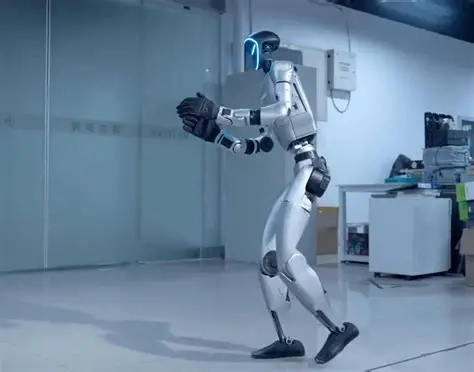
A humanoid robot (left) paired with its solid state battery pack (right), highlighting compact design and power efficiency.
2026: The Tipping Point for Robot Solid State Battery Commercialization
2025 saw the humanoid robot industry shift from “0-1” to “1-10” with tech convergence. 2026 pushes it past “1-10” to “10-100” scale, focusing on mass production. This growth spurs explosive demand for robot solid state battery.
Global shipments of humanoid robots will exceed 50,000 units in 2026, growing over 700% annually. Each robot needs high-performance power, making solid state battery a must-have. The sector is no longer experimental but commercially viable.
Xpeng’s IRON humanoid robot, launched in Nov 2025, uses an all-solid-state battery. It boasts 30% weight reduction and 30% power increase, wowing the market. Mass production is planned for late 2026, a milestone for the industry.
Battery leaders like CATL accelerate their solid state battery layout. CATL aims for small-scale solid-state production by 2027. This supports the soaring demand from the robot industry.
The Symbiotic Growth: Robots and Robot Solid State Battery
Humanoid robots and solid state battery form a mutually reinforcing cycle. Robots need advanced batteries to overcome power bottlenecks. Robot solid state battery gains a high-value use case to drive commercialization.
Tech breakthroughs in solid state battery lower costs for broader adoption. Cheaper batteries make humanoid robots more affordable for businesses and consumers. This expands the robot market further, creating more demand.
Robot solid state battery moves from laboratory to mass production eve in 2026. Humanoid robots provide the perfect application to test and refine the tech. Real-world use accelerates improvements in energy density and durability.
By 2035, humanoid robots could demand over 74 GWh of solid-state batteries. This is a thousand-fold increase from 2026 levels, showing massive long-term potential. The two sectors will grow in tandem for decades.
Key Challenges for Robot Solid State Battery (and Solutions)
High cost remains a major hurdle for solid state battery adoption. Current production processes are complex and expensive. Mass production with robot demand will drive economies of scale to cut costs.
Core technology gaps still exist for some high-performance requirements. Companies invest heavily in R&D to improve conductivity and lifespan. Collaboration between battery and robot firms speeds up breakthroughs.
Supply chain development lags behind demand for solid state battery. Manufacturers are scaling up material sourcing and production capacity. 2026 will see more stable supply chains to support mass production.
Industry standards for robot solid state battery are still emerging. Establishing uniform specs will simplify integration for robot makers. Leading firms are working together to define these critical standards.
Battewill: Powering Humanoid Robots with Robot Solid State Battery
Battewill develops cutting-edge robot solid state battery tailored for humanoid robots’ needs. Its batteries deliver 30% more power and 30% less weight than liquid alternatives, matching Xpeng’s benchmarks. Designed for safety and compactness, Battewill’s robot solid state battery fits tight robot torsos and avoids thermal runaway. It supports 4+ hours of dynamic runtime, solving endurance issues for 2026’s robot models. As humanoid robots spur new demand, Battewill’s reliable, high-performance robot solid state battery stands ready to power the industry’s growth.