E-VTOL, short for electric vertical takeoff and landing aircraft, is revolutionizing global transportation. 2025 marks a pivotal year as this technology moves from testing to large-scale commercial use. From cargo delivery to urban commuting, E-VTOL is breaking the limits of traditional travel with zero emissions. Its growth hinges on reliable power solutions, making battery technology a core driver of the E-VTOL revolution.
E- VTOL Application Scenarios: From Cargo to Passenger Travel
Cargo transportation leads the commercialization of E-VTOL with clear practical value. China’s Feihong Aviation delivered the V2000CG, a 1-ton class E-VTOL, in 2025. This aircraft carries 400kg payloads and flies 200km, ideal for island and mountain logistics. It has already secured over 1,000 intentional orders from logistics and energy companies.
Medical emergency is another critical E-VTOL use case. In Guangzhou, E-VTOL has tested organ and clinical sample transportation. These flights cut delivery time by 70% compared to ground vehicles, saving lives in time-sensitive situations. Operators are now applying for official certificates to scale these services.
Passenger E- VTOL: The Future of Urban and Intercity Travel
Passenger E- VTOL is approaching commercialization with exciting progress. EHang’s new VT35, a two-seat E- VTOL, launched in 2025 with a 200km range. It features autonomous flight and fits existing vertiports, lowering operational costs. The standard model is priced at 6.5 million RMB for early adopters.
Intercity routes will showcase passenger E-VTOL’s efficiency. Feihong’s “Shengshi Long” E-VTOL flies from Shenzhen to Zhuhai in 20 minutes. The 55km trip takes 2.5 hours by car, making E-VTOL a game-changer for business travel. Future fares may drop to 6 yuan per kilometer, opening to mass users.
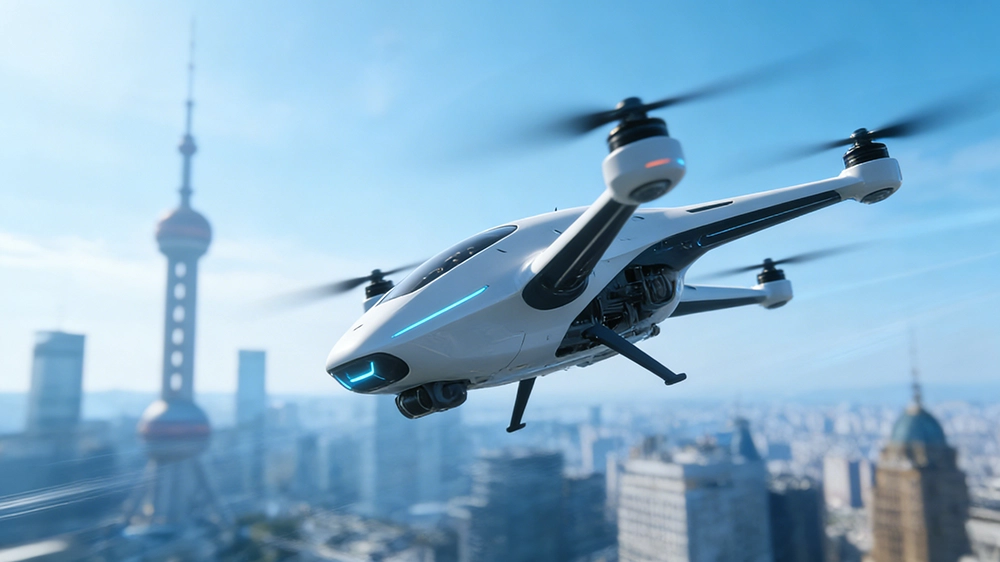
Global E-VTOL Leaders: Technology Routes and Competition
Chinese companies lead E- VTOL commercialization with policy and industrial support. Volocopter’s AE200 E- VTOL completed key flight tests in 2025. Its “eight-axis tilt-rotor” design balances stability and efficiency for urban use. It targets low-altitude tourism and emergency rescue markets.
American firms focus on autonomous and high-speed E- VTOL. Wisk’s Gen4 E-VTOL has finished 15,000+ autonomous test flights. It aims for 99.999% reliability, a key requirement for FAA certification. Archer’s Midnight E-VTOL enters mass production in 2025, with 650 units annual capacity.
Key Technologies Powering E- VTOL Advancement
Battery innovation is the backbone of E- VTOL performance. Leading models use high-density lithium-ion batteries with 350-450 Wh/kg. These batteries support fast charging and 1,500+ cycles for commercial viability. Solid-state batteries are in testing, promising 500+ Wh/kg by 2027.
Aerodynamic design and materials optimize E- VTOL efficiency. Most new models use carbon fiber composites to reduce weight. Distributed electric propulsion systems enhance safety with redundant power sources. These technologies cut energy use by 20% compared to early prototypes.
E-VTOL Industry Challenges and Future Outlook
Infrastructure remains a key challenge for widespread E- VTOL adoption. China’s Guangdong province is building a “1+3+N” vertiport network. It includes 1 provincial and 3 city-level flight service stations. This model may become a global blueprint for low-altitude economies.
Regulatory frameworks are catching up to E- VTOL innovation. China’s CAAC has issued “three certificates” for commercial E-VTOL. The FAA in the US is finalizing Part 23 standards for autonomous flight. Clear rules will accelerate E- VTOL integration into air traffic systems.
Market growth projections for E- VTOL are impressive. Analysts expect the global market to reach $1.3 trillion by 2040. Cargo E- VTOL will account for 40% of early revenue, with passenger services growing rapidly. Asia-Pacific will lead demand, driven by China’s urbanization.
Battewill: Powering the E-VTOL Revolution with Reliable Batteries
Every high-performance E- VTOL depends on stable, long-lasting power—and Battewill delivers. As a leader in specialty batteries, Battewill develops customized solutions for E- VTOL’s unique demands. Its lithium-ion batteries offer 420 Wh/kg energy density, supporting 200km+ range for cargo E-VTOL like the V2000CG.
For passenger models such as the VT35, Battewill’s batteries feature 30-minute fast charging (0-80%) to minimize turnaround time. They operate reliably in -20°C to 60°C, adapting to diverse climates from deserts to coastal areas. Equipped with advanced BMS for thermal control and safety, these batteries meet CAAC and FAA standards. Whether powering a heavy-duty cargo E- VTOL or a sleek passenger aircraft, Battewill provides the energy that moves the E- VTOL industry forward.