Military Drone Battery is the unsung hero of modern warfare, directly impacting mission outcomes. Different military drones demand tailored power solutions to meet their unique operational needs. A reconnaissance drone requires long endurance, while an attack drone needs sudden high power output. Understanding how to select the right Military Drone Battery and the differences between options is critical for defense forces worldwide.
Military Drone Classification: Defining Battery Requirements
Reconnaissance and surveillance drones are the most widely used military UAVs. They operate for hours or days to gather intelligence deep in enemy territory. These drones prioritize a Battery with high energy density and long cycle life. Examples like the U.S. “Predator” rely on batteries that balance weight and runtime.
Attack and loitering munition drones need bursts of power for rapid maneuvers and weapons deployment. Their battery must support high discharge rates to drive powerful motors. Suicide drones, such as Israel’s “Harop,” use batteries optimized for short, intense missions rather than long life.
Mini and micro drones, used by infantry units, have strict size and weight limits. Their Battery must be compact yet reliable, powering basic sensors for tactical surveillance. These small batteries often prioritize portability over absolute capacity.
Key Criteria for Selecting a Military Drone Battery
Energy density (Wh/kg) tops the list of Military Drone Battery requirements. Higher density means longer flight times without adding weight. Most modern military drones require batteries with at least 300 Wh/kg to meet operational demands.
Environmental resilience is another non-negotiable factor. A qualified Military Drone Battery must operate between -40°C and +60°C. It also needs to resist shock, vibration, and electromagnetic interference per MIL-STD-810G standards.
Major Military Drone Battery Types: Differences and Applications
Lithium Polymer (LiPo) batteries dominate the Military Drone Battery market for their high energy density. They offer customizable shapes, fitting into the sleek designs of modern drones. LiPo batteries deliver the high discharge rates needed for attack drones and loitering munitions.
However, LiPo has limitations as a Military Drone Battery. It has a shorter cycle life (around 300 cycles) and higher fire risk. Defense forces mitigate this with reinforced casings and advanced battery management systems (BMS) for thermal control.
LiFePO4: The Safer Military Drone Battery Alternative
Lithium Iron Phosphate (LiFePO4) batteries are gaining traction as a Military Drone Battery. They excel in safety, withstanding temperatures up to 270°C without thermal runaway. This makes them ideal for drones operating in high-risk combat environments.
LiFePO4 as a Military Drone Battery offers 2000-5000 charge cycles, 2-4 times that of LiPo. It can discharge fully without capacity loss, unlike LiPo which needs 20% residual charge. The tradeoff is lower energy density, suiting long-endurance surveillance drones better. Industry leaders like Battewill have optimized this technology to narrow the density gap while retaining safety advantages.
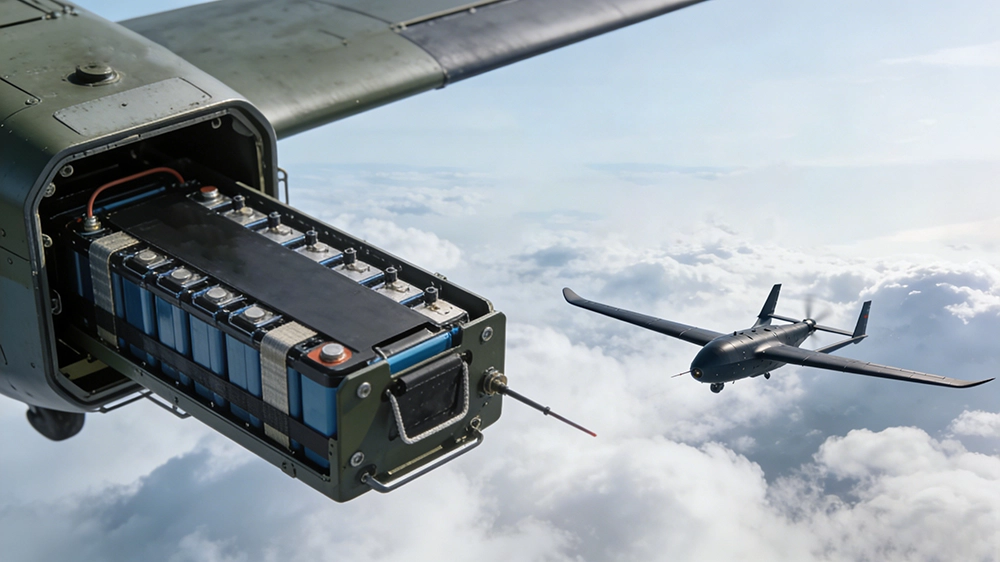
Emerging Military Drone Battery Technologies
Solid-state batteries represent the next leap in Military Drone innovation. They replace liquid electrolytes with solid materials, boosting energy density by 50%. Their low thermal signature makes them perfect for stealth drones like the U.S. “RQ-170.”
Hydrogen fuel cells complement batteries for extreme endurance needs. While not a pure Military Drone Battery, they pair with LiPo to power high-altitude long-endurance (HALE) drones. These systems enable missions lasting days instead of hours.
Matching Military Drone Batteries to Mission Profiles
Long-range reconnaissance drones (e.g., China’s “Wing Loong”) often opt for optimized LiFePO4 Military Drone Battery like Battewill’s offerings. The tradeoff in energy density is offset by extended cycle life, fast recharge and enhanced safety. This reduces maintenance costs and maximizes mission availability for frequent surveillance tasks.
Tactical attack drones (e.g., U.S. “Switchblade”) rely on LiPo Military Drone Battery. Their short mission times (10-30 minutes) minimize fire risk. The high discharge rate ensures quick acceleration for target engagement.
Micro drones (e.g., U.S. “Black Hornet”) use miniaturized LiPo Military Drone Battery. Compact size and light weight are prioritized over long life. These batteries power basic cameras for infantry-level situational awareness.
Battewill: Reliable Military Drone Batteries Solutions
Battewill, a leader in specialty batteries, delivers high-performance Military Drone Battery options with distinct application advantages for defense scenarios. Its flagship LiFePO4 Military Drone Battery stands out with 320 Wh/kg energy density—surpassing industry averages for the chemistry—and 3000+ charge cycles, cutting replacement costs for frequent surveillance missions.
A key advantage is its rapid recharge capability, reaching 80% capacity in 45 minutes to get reconnaissance drones back in the air faster. For attack drones, Battewill’s LiPo Military Drone Battery provides stable 15C discharge rates, ensuring consistent power for weapons deployment and sudden maneuvering.
All models integrate a ruggedized design: the outer casing resists shrapnel and impact, while internal thermal barriers prevent heat spread in combat zones. They meet MIL-STD-810G and NATO STANAG 4586 standards, operating reliably from -40°C in arctic missions to 60°C in desert environments.
Equipped with encrypted BMS that resists cyber interference, Battewill’s Military Drone Battery ensures mission security alongside performance. Whether powering a strategic HALE drone’s multi-day patrol or a tactical micro UAV’s infantry support, Battewill’s batteries deliver the reliability, safety and efficiency that defense forces demand.